Sample Profile

What a DCI profile shows, and what stays private

A DCI profile is a public, shareable page that shows a designer's latest published DCI Score, a score for each of the ten metrics, and the dates the assessment covers. Reviewer notes stay in a private view that only the designer can open.

All profile data on this page is sample data for a made-up designer.

Public view

The profile a visitor opens

Anyone with the link can open it, with no login.

Sample · for illustration onlyPublic profile
Sample DesignerConnected with LinkedIn

The name comes from the designer's Google account. A profile is visible to visitors only once LinkedIn is connected, and it links there so a visitor can see who they are.

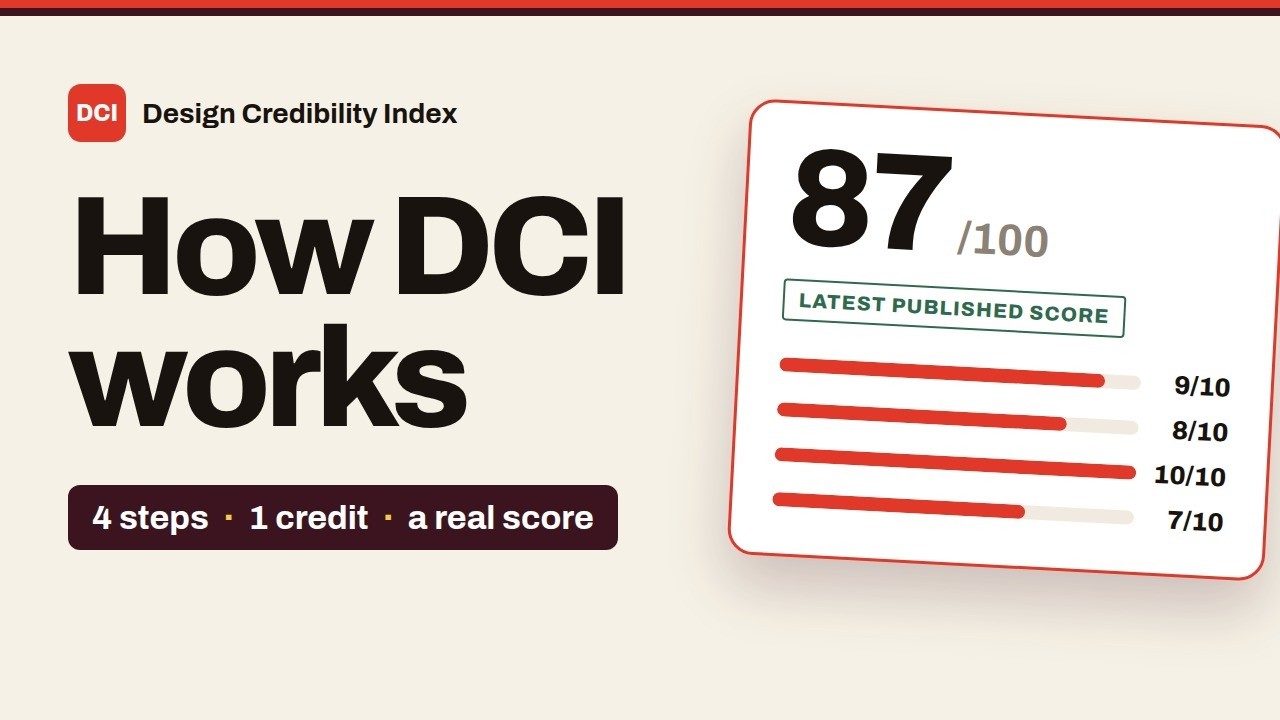
87/ 100
Latest published score

9 + 8 + 9 + 8 + 9 + 10 + 8 + 7 + 9 + 10 = 87

Submitted

Jan 12, 2027

Valid through

Jul 12, 2027

The submission date and the date six months later. The score stays on the profile after that date. The date tells a visitor how current it is.

Score breakdown, 10 metrics

  1. Research9/10
  2. Problem Definition8/10
  3. User Flow9/10
  4. Information Architecture8/10
  5. Wireframing9/10
  6. Visual Design10/10
  7. Interaction Design8/10
  8. Usability & Accessibility7/10
  9. Prototyping & Testing9/10
  10. Presentation & Communication10/10

Each is scored out of 10 and all ten carry equal weight. The total is the sum of the ten scores. See how each metric is defined.

app.designcredibilityindex.com/8vN2qXeJm4

Public profiles can be found by search engines. A designer can set the profile to private at any time, which removes it from view.
LinkedIn-connected

The name comes from the designer's Google account. A profile is visible to visitors only once LinkedIn is connected, and it links there so a visitor can see who they are.

A dated score

The submission date and the date six months later. The score stays on the profile after that date. The date tells a visitor how current it is.

The same ten metrics for everyone

Each is scored out of 10 and all ten carry equal weight. The total is the sum of the ten scores. See how each metric is defined.

A public page

Public profiles can be found by search engines. A designer can set the profile to private at any time, which removes it from view.

Example

A designer shares a link. A manager opens it on a phone.

A designer adds their DCI profile address to the portfolio field of an application. Between meetings, the hiring manager opens it on a phone. No login, no download.

  1. Check the datesWhen was this assessed, and is it recent?
  2. Scan the ten metricsWhere is the profile strong, and where is it lower?
  3. Choose a questionAsk the candidate to walk through the lowest-scored metric.

For hiring managers

How to read a profile

A DCI profile is optional supporting evidence, in the same way a portfolio link is. DCI is not designed as a pass/fail or shortlisting tool and makes no claim about how a company should weigh a score.

25+Already in use by design teams at 25+ product companies.
What it is
A trained human reviewer scored one case study, as submitted, against ten defined metrics. The same documented process applies to every submission.1
What it reflects
The submitted case study and nothing else. It does not measure hiring fit, and DCI does not guarantee employment outcomes. Designers confirm they own the work or are authorized to showcase it. DCI does not independently verify authorship.
What to know about it
The profile shows the latest approved score. A designer can submit again, and each submission is a new, independent evaluation. A completed assessment is final and is not renegotiated or appealed. A designer can also set the profile to private.
On a design team
Designers take the same assessment as everyone else and share their profile if they choose to. A manager sees the public view only. Profiles are for voluntary professional development and are not a performance-review input. How teams use DCI.

1 An 85-year meta-analysis of hiring research found that work-sample-style assessment predicts job performance more reliably than unstructured judgment (0.54 against 0.33, the latter for unstructured interviews). That research covers work-sample assessment in general. It makes no claim about DCI itself. Schmidt & Hunter (1998), Psychological Bulletin 124(2).

Private view

Feedback on each metric, kept private

Each submission has its own private page. The reviewer's note sits against the metric it is about. Who reviews a submission.

Every submission stays in this history, with its full breakdown and notes.
SubmissionReviewedScore
Checkout RedesignSubmitted Jan 12, 2027Jan 26, 202787 / 100
Onboarding Flow v1Submitted Sep 21, 2026Oct 5, 202674 / 100
Private · only the designerCheckout Redesign
87/ 100

Score and notes, 10 metrics

  1. Research9/10

    Reviewer noteInterview synthesis is clear and the quotes selected support the problem statement. The number of participants is not stated.

  2. Problem Definition8/10

    Reviewer noteThe problem is framed around the user. No measurable goal is stated for the redesign.

  3. User Flow9/10
  4. Information Architecture8/10
  5. Wireframing9/10
  6. Visual Design10/10
  7. Interaction Design8/10
  8. Usability & Accessibility7/10

    Reviewer noteContrast on the secondary buttons is below the recommended ratio, and form errors rely on color alone. User testing is shown. An accessibility check is mentioned but not shown.

  9. Prototyping & Testing9/10
  10. Presentation & Communication10/10

    Reviewer noteThe case study reads in one pass and each image supports a point in the text.

Notes are optional on each metric, so some rows have none.

Over time

When a designer submits again

A profile is created when the first credit is purchased. Every submission adds to the private history, and the profile shows the latest approved score.

  1. Profile showsNothing submitted

    Before the first submission

    Profile created

    Created when the first credit is purchased. Nothing to set up.

  2. Profile showsUnder review

    While under review

    Review in progress

    A trained reviewer scores the case study. Typically 10 business days.

  3. Profile shows74/ 100

    After approval

    Score published

    The score and breakdown appear on the profile. The notes appear in the private view.

  4. Profile shows87/ 100

    After the next submission

    Newest score replaces it

    Once approved, the newer score becomes the public score, whether it is higher or lower. The earlier 74 stays in the private history.

A newer submission that is still under review does not change what visitors see. They keep seeing the last approved result until the next one is ready.

Can a company see the reviewer's notes?

No. Notes belong to the designer. A company sees what any visitor sees.

A profile is visible to visitors only when it is set to public and LinkedIn is connected. Until then, only the designer can see it.
InformationVisitorsDesigner
Name and LinkedIn linkYesYes
Latest published score and the ten metric scoresYesYes
Submission and valid-through datesYesYes
The reviewer's note on each metricNoYes
Every earlier submission and its scoreNoYes
Credit, payment history and account settingsNoYes

Watch the Walkthrough

See how a score, feedback and a profile come together.

The walkthrough follows a submission from case study to score, feedback and profile.

Questions

Profile FAQ

A public, shareable page that shows a designer's latest published DCI Score, a score for each of the ten metrics, and the dates the assessment covers. Reviewer notes are not part of it.

No. Reviewer notes are private to you. Employers and other visitors see only the score, the ten metric scores and the dates.

Yes. The date shows when the assessment was done and how current it is. The profile stays up until you submit again and are approved, or set it to private.

Yes. You can set it to private at any time, and it then stops being visible to visitors.

See all FAQs

From assessment to interview

Start whenever you're ready.

One assessment goes three places: into your private history, onto an application, and into the interview conversation.

Hiring designers? See For Teams

The designer · private history

  • Onboarding Flow v1Reviewed Oct 5, 202674
  • Checkout RedesignReviewed Jan 26, 202787

+13 since the first assessment

  • Problem Definition68
  • Usability & Accessibility57

Every result stays in your private history, so you can compare them metric by metric.

The designer · a job application

Portfolio link

portfolio.example/sample-designer

DCI profile optional

app.designcredibilityindex.com/8vN2qXeJm4

Submit application

The profile link goes into an application the same way a portfolio link does.

The hiring manager · reading the profile

87/ 100Submitted Jan 12, 2027

  • Visual Design10
  • Research9
  • Usability & Accessibility7

Interview questionWalk me through how you checked accessibility on the checkout redesign.

Read next to the portfolio, the lowest metric becomes a question for the interview.

Example with sample data. A DCI profile is supporting evidence for a conversation. It is not designed as a shortlisting tool.